AI is changing web development by drafting code, layouts, tests and content that developers then review and correct. Websites get built faster, but the work shifts toward checking security, accessibility and quality. AI is also changing what a site needs to do, because more people now meet businesses through AI search summaries and chat tools.
That short version hides a lot of nuance. The research on AI and developer speed points in different directions, AI-written code fails security checks surprisingly often, and some "AI will fix your website" products have already drawn action from regulators. Below are the eight changes that matter most, with sources, and what each one means if you are the person paying for a website.
What has AI actually changed in web development?
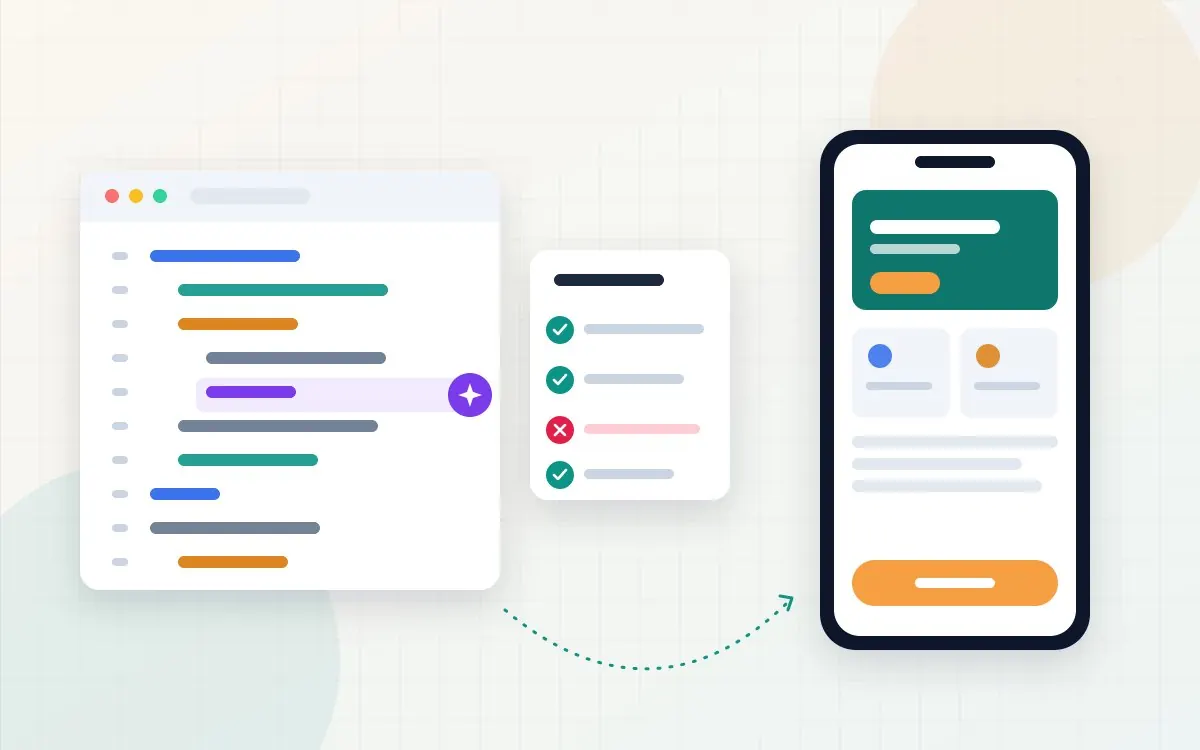
AI in web development means using large language models and related tools to produce or check the parts of a website that used to be written entirely by hand: code, page layouts, test scripts, text and image descriptions. The biggest shifts so far:
- Code is drafted by AI and edited by developers.
- Design ideas and prototypes appear in hours, not days.
- Testing and debugging are faster, with a new kind of bug.
- Security review has become more important, not less.
- Accessibility checks are easier to run, but cannot be automated away.
- Websites now ship with AI features of their own.
- Search is changing how visitors arrive.
- The developer's job is moving from typing to judgement.
Web development tasks before and with AI
| Task | Before AI tools | With AI tools | Still needs a person for |
|---|---|---|---|
| Writing routine code | Typed by hand or copied from old projects. | First draft suggested in seconds. | Checking it is correct, secure and fits the rest of the site. |
| Page layouts | Sketches and mockups over several days. | Several rough options in an afternoon. | Choosing what suits the brand and the customer. |
| Tests | Often skipped on small projects because of time. | Test cases drafted from the code. | Deciding what actually needs testing. |
| Finding bugs | Reading error logs and searching forums. | Error explained and a fix suggested. | Confirming the fix does not break something else. |
| Image alt text and captions | Written one by one, or forgotten. | Drafted automatically. | Making sure the description is accurate and useful. |
| Website copy | Written from a blank page. | A draft to react to. | Facts, tone and anything specific to the business. |
| Customer questions on the site | Contact form or phone only. | A chat assistant that answers common questions. | Setting what it may say and handing over to a human. |
1. Code is drafted by AI, then edited by developers
AI coding assistants are now normal working tools. In the 2025 Stack Overflow Developer Survey, 84 percent of respondents said they use or plan to use AI tools, and 51 percent of professional developers use them every day. The assistant suggests the next few lines, writes a whole function from a plain-English request, or converts code from one framework to another.
Whether that makes developers faster depends on the task. In a controlled experiment by GitHub and Microsoft researchers, developers using Copilot finished a set programming task 55.8 percent faster than those without it. The task was writing a small web server from scratch, which is exactly the kind of well-defined job AI handles well.
A 2025 randomised trial by the research group METR found the opposite in a different setting. Sixteen experienced developers working on large codebases they already knew well took 19 percent longer when they were allowed to use AI tools, even though they believed the tools had made them about 20 percent faster. The authors are careful to say their result does not prove AI slows down most developers. What the two studies show together is that AI helps most with new, self-contained pieces of work and least with large, established code where the context matters more than the typing.
2. Design ideas and prototypes appear in hours
Design tools can now turn a written description or a rough sketch into a clickable layout. For a business owner, that means seeing three or four directions for a homepage early in a project, before much money has been spent, and reacting to something real rather than a verbal description.
The limit is that AI layouts are built from patterns it has seen many times, so they tend to look like every other site. A layout that works for your customers still comes from understanding who they are and what they need to do on the page. That is what UX design is for, and it is the part AI cannot guess.
3. Testing and debugging are faster, with a new kind of bug
Paste in an error message and an AI assistant will usually explain it in plain words and suggest a fix. It can also draft automated tests, which small projects often skipped because nobody had time to write them.
The catch is a new kind of problem: code that looks right and nearly works. In the same Stack Overflow survey, the most common frustration, reported by 66 percent of developers, was AI answers that are "almost right, but not quite", and 45 percent said debugging AI-generated code takes longer than they expected. Only 33 percent said they trust the accuracy of AI output. Developers who use these tools every day are the ones most aware of their mistakes.
4. Security review matters more, not less
This is the change that should concern business owners most. When Veracode tested code from more than 100 AI models, 45 percent of the samples failed security tests and introduced well-known vulnerabilities. For cross-site scripting, one of the most common ways websites are attacked, the AI tools failed to write safe code in 86 percent of relevant samples.
AI-written code is not always worse than human code, but it is produced faster than anyone can comfortably review it, and it often looks confident and tidy while hiding the flaw. On a small business website, the risk is usually in contact forms, login areas, file uploads and plugins. Most break-ins still happen through outdated plugins and weak passwords that automated scanners find, and AI-generated code adds one more route if nobody checks it.
5. Accessibility checks are easier, but cannot be automated away
AI tools can draft image descriptions, flag low-contrast text and point out missing labels on forms. That makes a basic accessibility review cheaper to run, which is good news for people who use screen readers and keyboard navigation.
What AI cannot do is make an inaccessible website accessible by adding a script. In 2025 the US Federal Trade Commission ordered accessiBe to pay $1 million over claims that its AI-powered plugin could make any website compliant with the Web Content Accessibility Guidelines (WCAG). Accessibility has to be built into the page structure, the content and the design, then tested by people.
6. Websites now ship with AI features of their own
AI is also changing what goes on the website itself. Features that were expensive a few years ago are now within reach of a small business:
- Chat assistants that answer opening hours, pricing and service questions at any time, and pass harder questions to a person.
- Smarter site search that understands "something for a leaking roof" rather than needing the exact product name.
- Enquiry routing that reads a form submission and sends it to the right person with a summary.
- Product descriptions and summaries drafted for large catalogues, then edited by staff.
Each of these needs careful limits. A chat assistant that invents a price or a policy creates a customer-service problem, so the useful ones only answer from content the business has approved. We cover what works in practice on our AI and business automation page.
7. Search is changing how visitors arrive
Google now shows AI-generated summaries above many results, and people click less when they see one. A Pew Research Center study of real browsing data found that users clicked a regular search result in 8 percent of visits when an AI summary appeared, compared with 15 percent when it did not. Links inside the summary were clicked in only 1 percent of visits.
That has two practical effects on how websites are built:
- Pages need to answer questions clearly and early. Content that states the answer, shows who wrote it and backs it up is more likely to be quoted and trusted.
- The visitors who do click are further along. They have often read the summary already, so the page they land on has to make the next step, calling, booking or buying, fast and obvious.
There is no special trick for appearing in AI results. Google's own guidance says there are no additional requirements or special optimisations for AI Overviews beyond normal search best practice, and no special files or markup are needed. Be wary of anyone selling an "AI SEO file" as a shortcut. Fast pages, clear structure and useful content, the basics of technical SEO and performance, still do the work.
8. The developer's job is moving from typing to judgement
When AI writes the first draft, the valuable skills move elsewhere: understanding what the business needs, choosing the right structure, reviewing code for security and speed, and testing on real devices. Knowing when the AI is wrong matters more than typing quickly.
Demand for that work has not disappeared. The US Bureau of Labor Statistics projects employment of web developers and digital designers to grow 7 percent from 2024 to 2034, much faster than the average for all occupations. Routine work, such as building a simple page from a template, is the part most exposed to automation.
Will AI replace web developers?
Not on current evidence. AI can produce a large share of the code on a typical website, but someone still has to decide what to build, spot the mistakes, fix the security gaps and take responsibility when something breaks. Developers themselves are cautious: in the 2025 Stack Overflow survey, 72 percent said "vibe coding", building software purely from AI prompts without reviewing the code, is not part of their professional work.
What is changing is the size of team needed. One experienced developer with good AI tools can now handle work that used to need several people, which is part of why small, founder-led studios can take on projects that once needed an agency.
Can AI build a whole website on its own?
AI website builders can produce a simple, good-looking site from a few sentences in minutes. For a personal page, an event or a quick test of an idea, that can be enough.
For a business website, the gaps show up quickly:
- The text is generic until someone rewrites it with real details, prices and proof.
- Layouts follow common patterns rather than what your customers need to do.
- Speed, accessibility and security are rarely checked.
- Moving the site to another host or developer later can be difficult or impossible.
- Nobody is responsible when a form stops sending enquiries.
What AI means if you are paying for a website
For business owners, the changes above come down to cost, speed and the questions worth asking.
Cost. AI lowers the cost of producing a first draft, not the cost of getting a site right. Prices for simple sites have come down, but strategy, custom work, testing and ongoing care still take skilled time. Our guide to what a business website actually costs explains where the money goes.
Speed. Early drafts arrive much sooner, which is useful for feedback. Launch dates are still set by content, decisions and testing.
Questions to ask any developer or agency:
- Which parts of my site will be AI-generated, and who reviews them?
- How is the code checked for security before launch?
- How do you test accessibility, beyond an automated scan?
- Will any of my customer data be pasted into AI tools?
- Do I own the code and content, and can I move the site later?
- Who fixes it, and how quickly, if something breaks after launch?
Clear answers to those six are a better sign of quality than whether a developer uses AI at all.
How I use AI when building websites
I build websites and web apps, and I use AI tools every working day. They speed up the first drafts of layouts and code and let me try an idea quickly before committing to it. They are also good at explaining an unfamiliar error or an old piece of code a client has inherited.
Every page is still designed, reviewed and tested by hand on real phones before a client sees it. I read any code that handles forms, logins or payments line by line, because that is where AI's confident mistakes do the most damage. More on how projects run is on the web development page.
Frequently asked questions
AI is used to draft code, suggest page layouts, write automated tests, explain errors, generate image descriptions and draft website text. Developers review and correct the output. AI is also built into websites as chat assistants, smarter site search and automated enquiry handling.
Yes, but the skills in demand are changing. The US Bureau of Labor Statistics projects 7 percent growth for web developers and digital designers from 2024 to 2034. Routine template work is most exposed; problem-solving, security, performance and understanding clients are becoming more valuable.
Only after review. Veracode found that 45 percent of AI-generated code samples failed security tests. AI code should be read and tested like any other code, with extra care around forms, logins, file uploads and payments.
It makes the first draft cheaper and faster. Simple sites cost less than they used to, but planning, custom features, testing, security and maintenance still take skilled time, so a well-built business website has not become free.
Not with special files or tricks. Google says there are no extra requirements to appear in AI Overviews. Clear answers near the top of pages, accurate information, fast loading and an obvious next step for visitors help with both AI summaries and normal results.
Where to start
If you already have a website, the most useful AI-era check takes an afternoon: make sure your main pages answer your customers' common questions in the first few lines, that the site loads quickly on a phone, and that plugins and passwords are up to date. If a developer is building something new for you, send them the six questions above before you sign.